Learn the MCAT the way
your brain actually remembers.
Every hard science concept — Biology, Biochem, O-Chem, Physics, Psych/Soc — taught through vivid analogies, funny cartoon images, and stories that stick. Plus a full question bank, CARS passage analyzer, spaced-repetition homework, and dimensional analysis practice.
Mitochondria — the cell's power-plant city 🏭
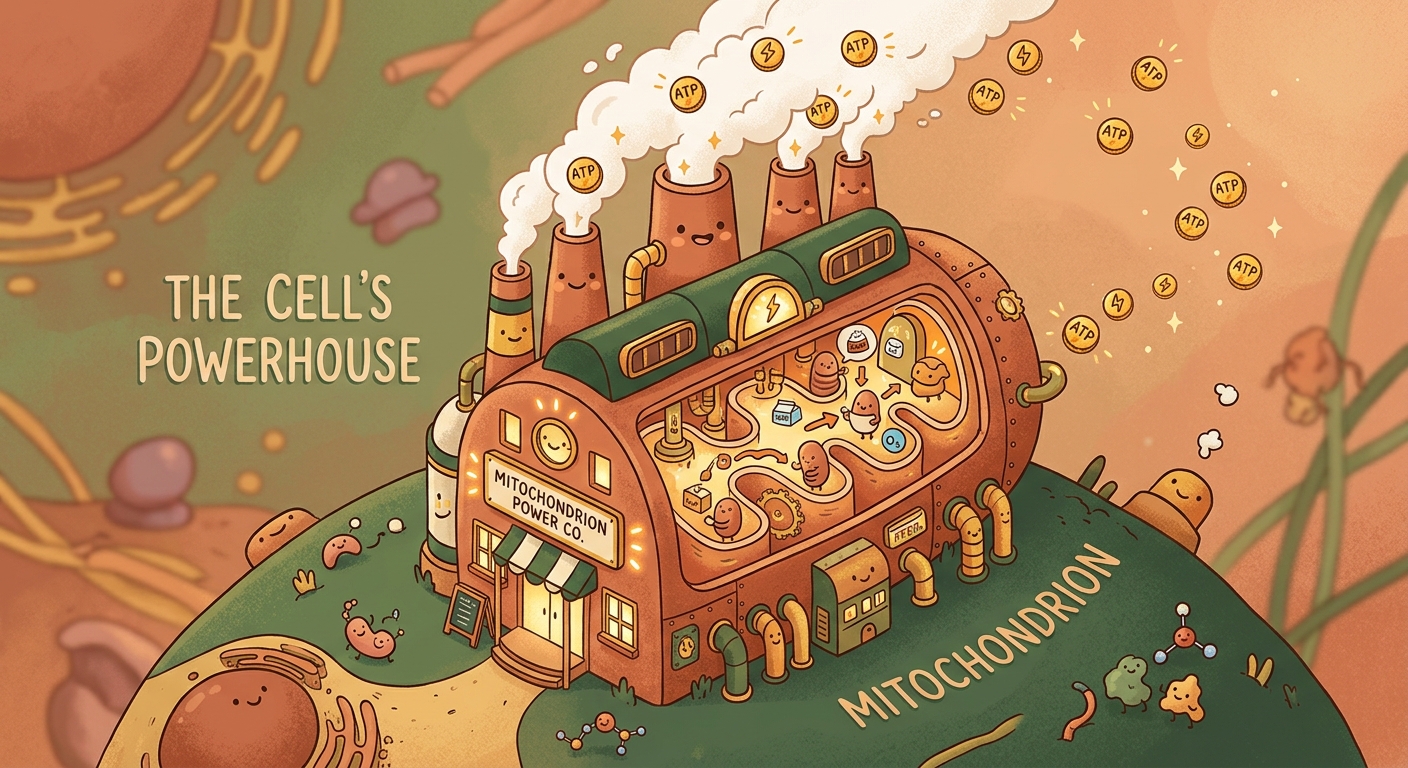
Mitochondria are the powerhouses of the cell — like tiny nuclear reactors humming inside every cell, converting the 'fuel' (glucose + O₂) into usable currency (ATP).…
Sit a real MCAT block — for free.
Answer 3 sample questions from our 230-question full-length test. Get instant feedback and an explanation for each. Unlock the rest — plus timing, weak-area analysis, and section scoring — when you upgrade.
A biochemist studies a mutant strain of yeast that cannot grow on glucose alone, but grows normally on pyruvate. Enzyme assays show wild-type activity for pyruvate dehydrogenase and every enzyme of the citric acid cycle. Glycolytic intermediates upstream of pyruvate accumulate in the mutant.
Which enzyme is most likely defective in the mutant strain?
A rigid 2.0 L vessel contains 0.50 mol of an ideal gas at 300 K. The gas is heated at constant volume until the pressure doubles.
What is the final temperature of the gas?
The romantic view of the lone inventor persists in popular culture, but the historical record tells a subtler story. Nearly every celebrated breakthrough — the telephone, the airplane, the transistor — was preceded by a decade of overlapping work by rivals converging on the same problem. What we call "invention" is often the moment a public credit system catches up with a private consensus.
The author's primary purpose in this paragraph is to:
+226 more questions on Plus
Unlock the full 230
Free gets you 1 half-length test.
Plus gives you unlimited full-length tests with timing modes, per-section scores, and weak-area retargeting.
Three habits that make MCAT content stick.
Analogies + Stories
Every topic paired with a vivid analogy, a memorable story, and a funny cartoon image generated on demand.
Question Bank + CARS
Challenging MCQs across all AAMC content categories. Real-length CARS passages with AI breakdowns.
Spaced Repetition
Weakest topics surface first. Homework queue reminds you before you forget.
See how it all connects.
One MCAT idea usually lives across 3 subjects. PictureMed maps the biggest cross-discipline threads so you stop siloing biology, chemistry, and physics.
Start free — 1 theme unlocked instantlyThe Action Potential Is an Electrochemistry Problem
Neurons fire because ion pumps set up a battery — every biology fact about firing rate maps onto a chemistry equation.
→ Resting potential is the Nernst equation applied to K+ leak channels; threshold and firing are Ohm's law on a leaky capacitor.
Oxygen From Air to Mitochondrion
Every breath crosses 4 disciplines: fluid dynamics, gas laws, protein binding, and cellular respiration.
The Body Is a 24/7 Buffered Solution
Blood pH stays at 7.4 ± 0.05 through three overlapping systems — one chemistry, one respiratory, one renal.
Enzyme Kinetics = Rate Laws With Extra Steps
Michaelis-Menten is just chemistry's rate law wearing a lab coat — the same math predicts drug pharmacology.
ATP Is a Thermodynamics Problem
The Second Law says entropy increases — cells fight this by coupling reactions with a big negative ΔG.
+ 10 more cross-discipline threads on Plus
Pick a plan. Cancel any time.
Every plan includes the built-in analogy + story explanations, spaced-repetition homework queue, and CARS passage analyzer. The searchable Image Library and premium features unlock on Plus. Paid plans refresh your Open Topic Credits every month.
- 6 one-time Open Topic Credits
- Access to Subjects tab
- Limited access to curated Question Bank practice
- 1 free half-length practice test
- Flashcards + spaced-repetition Homework queue
- Everything in Free
- 10 Open Topic Credits refreshed every month
- Unlimited access to the existing Question Bank across every subject
- Unlimited half-length & full 230-question practice tests
- Image Library — browse the full analogy gallery
- Everything in Plus
- 20 Open Topic Credits refreshed every month
- Community Analogy Library — unlimited saves
- Early access to every new PictureMed feature
- Priority support (24-hr response)
Need more credits without upgrading? Grab a one-off credit pack after signup — 5, 10, or 20 credits.